

It usually starts with a sentence, not a document.
A supervisor points at a section of slab where the drawings changed overnight and says, "Fix that first, we'll sort it out later." Two of your crew spend the afternoon on it. Nobody writes anything down, because the pour is tomorrow and everyone is busy.
Six weeks later your payment claim comes back with that line struck out. The supervisor has moved to another job. The builder's contract administrator, who was never on site, asks a fair question: where is the record?
This guide is about that gap. It covers what to record when extra work is directed, who needs to sign it, and how that record reaches a payment claim under the NSW security of payment laws. It is written for subcontractors in New South Wales, especially labour-heavy trades such as steel fixing, formwork and concreting, where extra work mostly means extra hours.
The short version#
- Extra work is only as strong as the record made on the day it happened.
- Day labour and variations are different things. A variation changes what you were contracted to do. Day labour is one way of paying for it: by the hour, at agreed rates.
- Most subcontracts set a deadline for giving written notice of a variation. Miss it and you can lose the claim, however fair it is.
- In NSW a builder has 10 business days to answer a payment claim with a payment schedule. If they don't, they become liable for the full amount claimed.
- The hours on a docket are the same hours you need for pay records and job costs. Record them once, where the work happens.
Why this matters now#
More construction companies fail than companies in any other industry in Australia. In the 2025-26 financial year, 3,472 construction companies entered external administration or had a controller appointed for the first time, according to ASIC's insolvency statistics. That is about one in four of all the companies that did, and more than any other industry. (ASIC marks its most recent figures as provisional.)
When money is tight further up the chain, the claims that are easiest to dispute tend to be cut first. Extra work with no paper behind it is easy to dispute.
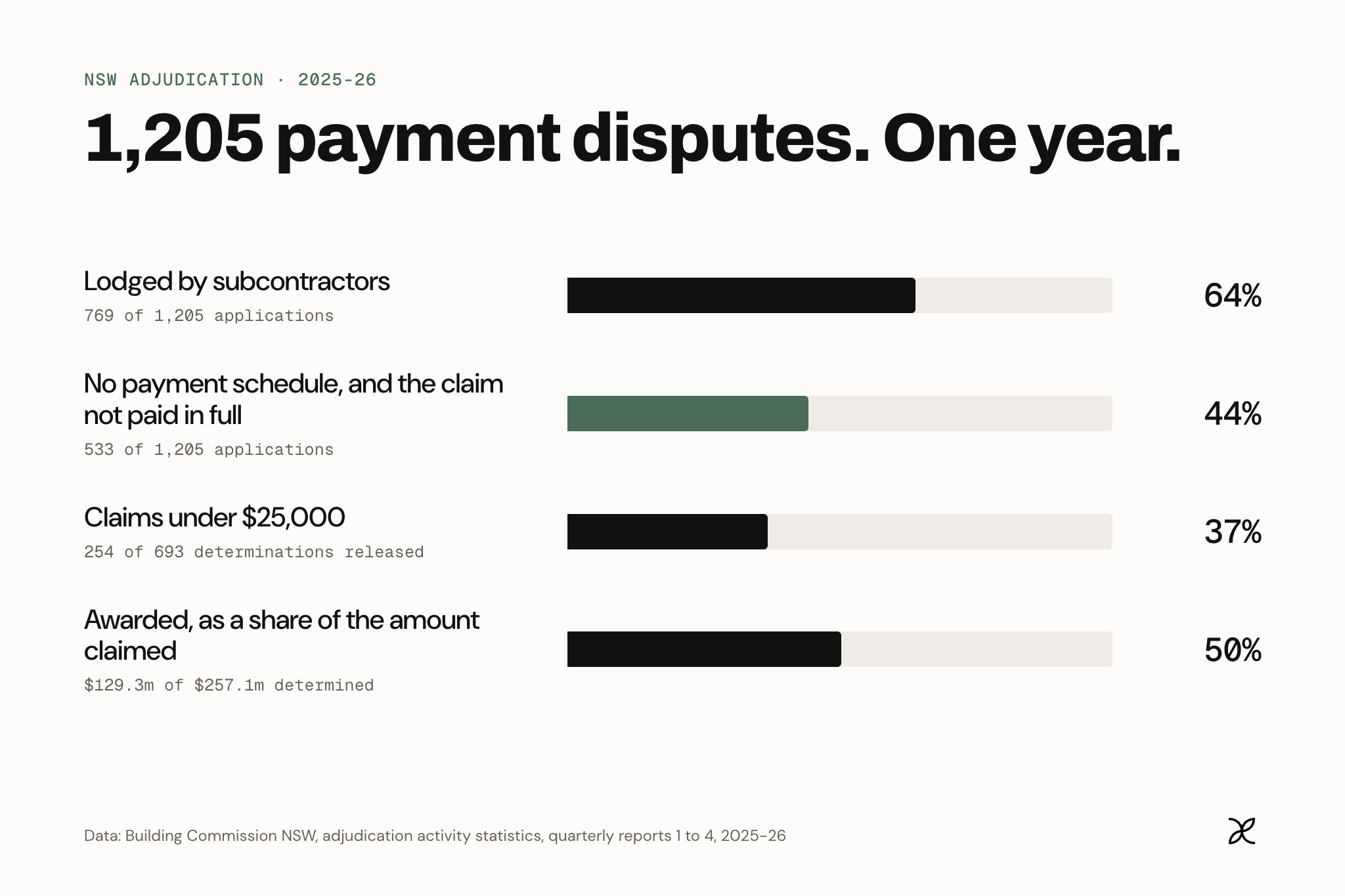
The NSW dispute figures point the same way. Building Commission NSW's adjudication reports record 1,205 adjudication applications in 2025-26, over payment claims worth $496.6 million. Subcontractors lodged 769 of them, close to two in three. And 533 applications, 44% of the total, were lodged because the other party neither sent a payment schedule nor paid the claim in full by the due date.
Adjudication is not only for large claims. Of the 693 determinations released during the year, 254 were for claims under $25,000.
One more number is worth knowing. Across those determinations, adjudicators awarded $129.3 million against $257.1 million claimed, which is about half. An adjudicator works from the written material the two sides put in front of them. A claim that arrives with signed dockets, photos and a clear instruction is in a different position from one that arrives with a spreadsheet.
Day labour and variations are not the same thing#
A variation is a change to the work you were contracted to do: more of it, less of it, or something different. A relocated penetration, an extra pour, a redesign after the steel was fixed.
Day labour is a way of paying for work by time, instead of by the tonne, the square metre or a lump sum. Contracts usually call it daywork. It is used when nobody can price the work in advance, which is often the case with a variation directed on the spot.
One afternoon can involve both: a variation (the extra work) valued as day labour (hours at agreed rates). Each asks something different of you. A variation needs a valid instruction and notice under your contract. Day labour needs a daily record of what was actually used.
GC21, a standard contract the NSW Government uses for its own construction projects, shows how much weight that record carries. Its daywork schedule requires the contractor to "record the particulars of all resources used by the Contractor each day", using a method of recording the two parties have agreed. A claim for daywork must come with "all time sheets, wages sheets, invoices, receipts and other documents that are necessary to support" it. The work is then valued from those records: wages and allowances, statutory on-costs, plant hire and materials, plus a set margin for overheads and profit, which is 22.5% in the standard form.
Your subcontract will have its own wording and its own rates. The principle carries over. Day labour is paid on records, so without a record there is nothing to value.
Why extra work goes unpaid#
In our reading of the contracts, the guidance and the cases, unpaid extra work usually comes down to one of three gaps.
The instruction was verbal. Most subcontracts say who can direct a variation and require the direction in writing. A foreman's word on site may not count as a direction under the contract, even when everyone acted on it.
The notice was late. One national law firm describes strict notice requirements and time bars as "ubiquitous in Australian construction contracts". A typical clause gives you a set number of days to tell the builder in writing that you consider something a variation, and says the claim is barred if you don't. Courts generally enforce a clearly worded time bar even when the result is harsh.
The record came later. A docket written from memory at the end of the month, unsigned, with round numbers such as "2 men, 8 hours", gives the builder's contract administrator nothing to check and every reason to cut.
There are legal arguments that can rescue a claim without the paperwork. In 2021 the NSW Court of Appeal held that a client who had directed extra work, and had paid earlier variations without insisting on the contract's notice procedure, could not later use that procedure to refuse payment (Valmont Interiors v Giorgio Armani Australia). Those arguments are slow, expensive and uncertain. A signed docket is none of those.
A docket written a month later is an argument. A docket signed that afternoon is evidence.
What a day labour docket needs to show#
A docket has one job: to let someone who was not there confirm what happened.
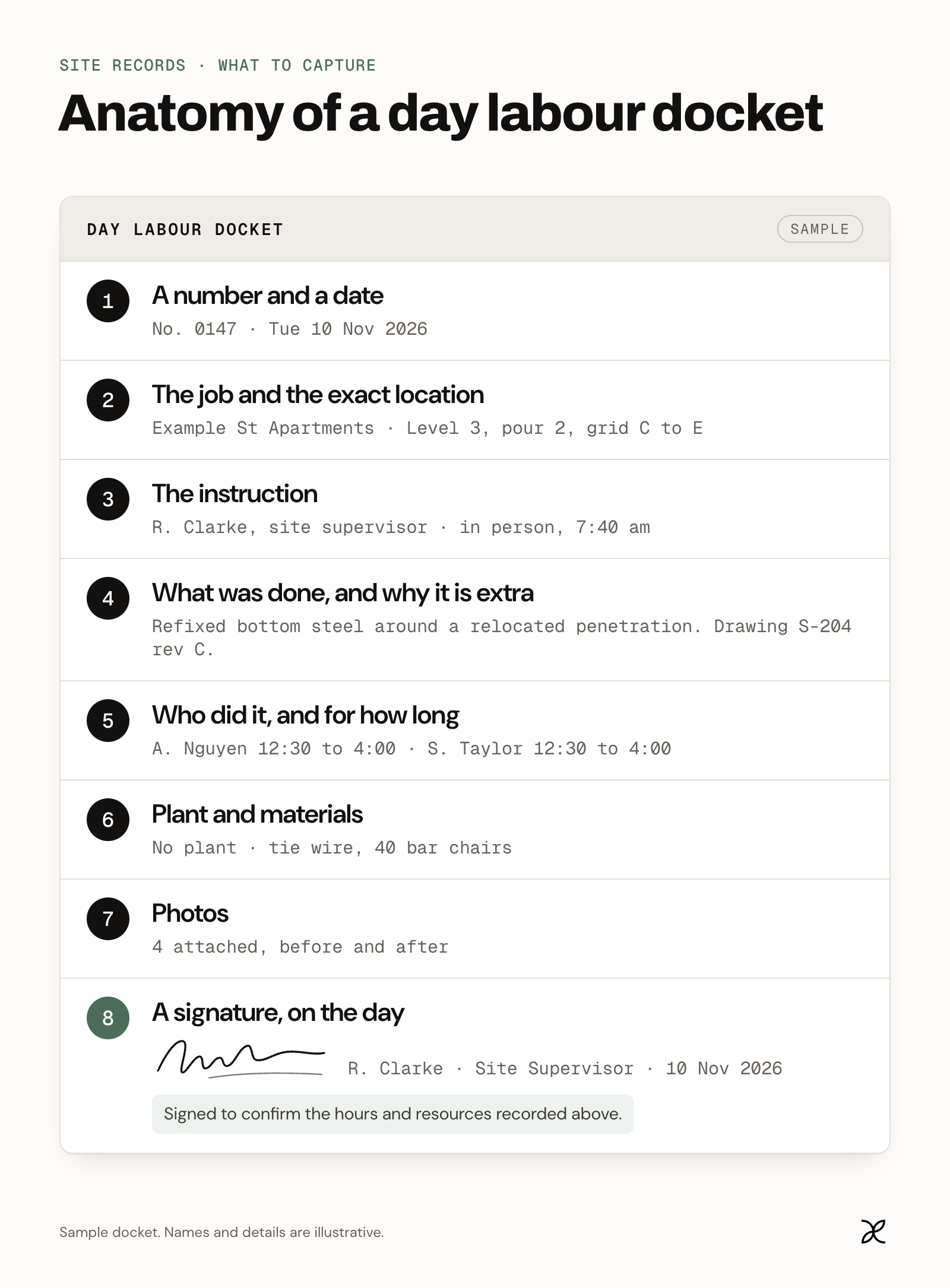
- A number and a date. Sequential docket numbers stop arguments about missing or duplicated sheets.
- The job and the exact location. Project, level, pour or gridline. "Level 3, pour 2, gridlines C to E" can be checked against the program. "Site" can't.
- The instruction. Who directed the work, their position, when, and how: in person, by text, by email or under a site instruction number.
- What was done, and why it is extra. One or two plain sentences, with the drawing revision if there is one.
- Who did it, and for how long. Each worker by name and classification, with start and finish times. Real times, not rounded totals.
- Plant and materials. Anything brought in or used up for this work only.
- Photos. Before and after, taken on the day.
- A signature from the builder's representative. With their printed name, position and the date, on the day.
One more line is worth adding: what the signature means. Some site staff will confirm hours but have no authority to agree a price, or to accept that the work is a variation at all. That is fine. A line such as "Signed to confirm the hours and resources recorded above" lets a supervisor sign what they can honestly confirm. Whether you are entitled to be paid can be argued later. The facts cannot be rebuilt later.
Get it signed the same day#
Timing does most of the work. On the day, the supervisor remembers giving the instruction and can see the crew doing it. A month on, they may be on another project, and the person assessing your claim has only the paper.
If they won't sign, send it anyway. Email or text the docket and photos that afternoon to the builder's site contact, and to whoever your contract names for notices. Start with "Confirming your instruction today to" and describe the work. A dated message that goes unanswered is still a record made at the time.
Then give notice the way your contract says. The docket is the record. The notice is a separate step, with its own deadline and its own addressee. Read the clause once at the start of the job and put the deadline where your office will see it.
Paper or phone? Use whatever the builder's site team will sign. If that is a paper docket book, keep using it, and photograph every signed page before the book leaves site. If they will sign on a phone, the photo, the time and the place are captured for you. Either way, agree the method when the job starts. GC21 takes the same approach: the two parties agree how resources and hours will be recorded.
From docket to payment claim#
A docket gives you a record. A payment claim gets you paid. In NSW the Building and Construction Industry Security of Payment Act 1999 sets the timetable, and it applies whether your contract is written, verbal or absent.
The steps below follow NSW Government guidance for contracts signed on or after 21 October 2019.
- Claim every month. You can serve a payment claim on or after the last day of the month in which the work was first carried out, and the last day of each month after that. Your contract may allow an earlier date. Unless it says otherwise, you get one claim a month.
- Make the claim valid. Put it in writing, describe the work, state the amount, and state that it is a payment claim made under the Act.
- Attach the evidence. The guidance lists statements of the work completed, delivery dockets and photographs among the attachments a claim can carry. Give every day labour line a docket number, and attach the docket.
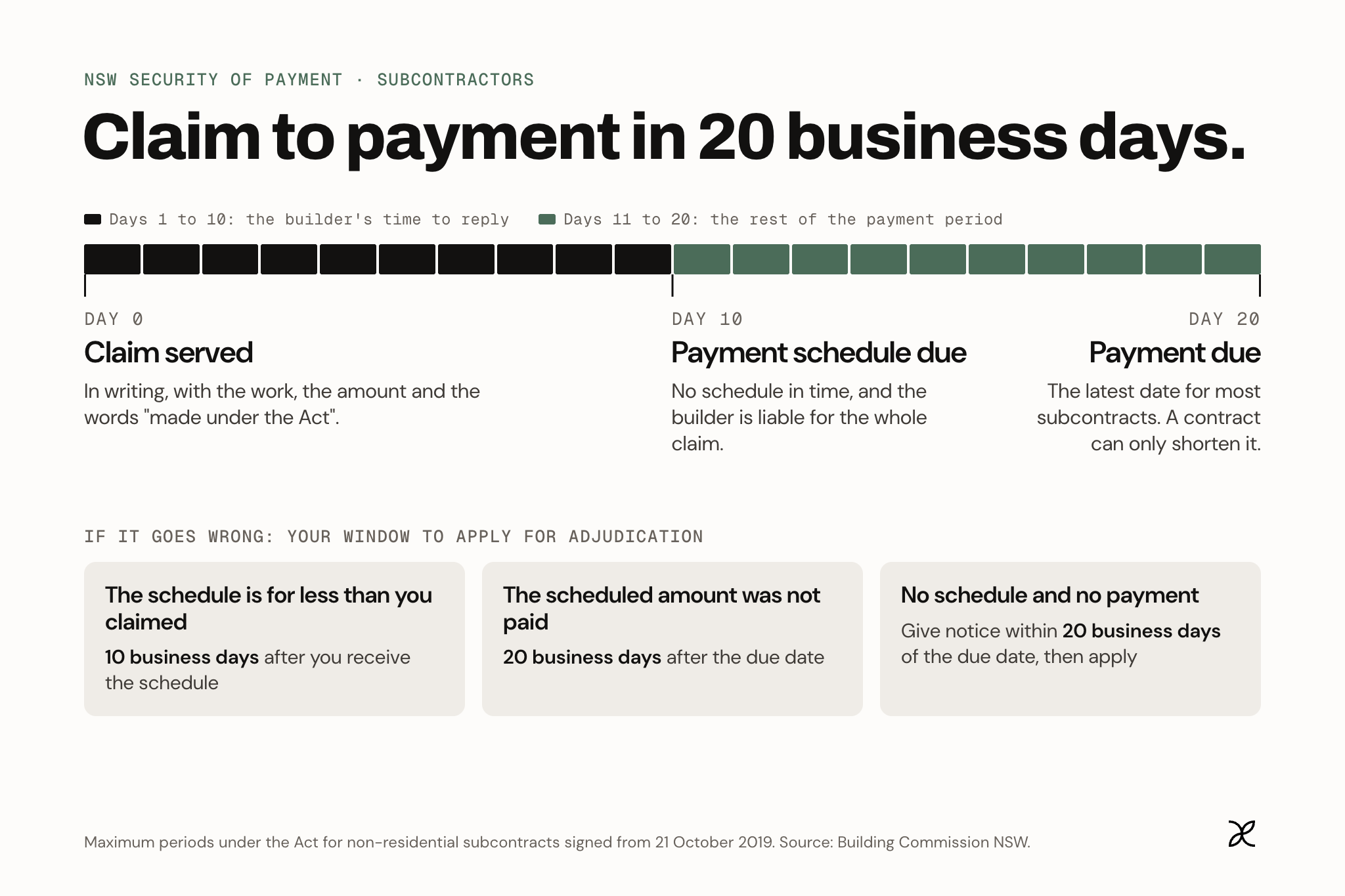
- Watch the reply. The builder has 10 business days, or less if the contract says so, to give you a payment schedule: what they will pay, and their reasons for withholding the rest. If no schedule arrives in time, they are liable for the whole claim.
- Know the due date. For most subcontracts, payment is due no later than 20 business days after the claim. A contract can make it earlier, never later. Some residential work has a shorter period.
- Act inside the window. If the claim is cut or goes unpaid, adjudication has its own deadlines, set out below.
| What happened | Your deadline to apply for adjudication |
|---|---|
| The payment schedule is for less than you claimed | 10 business days after you receive the schedule |
| The scheduled amount was not paid by the due date | 20 business days after the due date |
| No schedule and no payment | Give notice within 20 business days of the due date. The builder then has 5 business days to provide a schedule, and you have 10 business days after that to apply |
Three details catch people out. Business days exclude weekends, public holidays and 27 to 31 December, which matters for a claim served just before the Christmas shutdown. Work you haven't claimed yet can go into a later claim, but only within the period your contract sets or 12 months after the work was last carried out, whichever is later. And a clause that makes your payment depend on the builder being paid first has no effect: the Act prohibits "pay when paid" provisions.
Every deadline here is short, and every one starts from a dated document. The scheme is built to be fast, and it rewards the party whose records are ready.
Hours you only record once#
The hours on a day labour docket are not a separate set of numbers. They are the same hours three different audiences already need from you.
- Your workers and the Fair Work Ombudsman. Employers must keep time and wages records for seven years, legible and in English. The records must show overtime hours with start and finish times, and the hours of casual employees who are paid by time worked. They cannot be changed except to correct an error. Where records were not kept, an employer can be required to prove in court that it did not underpay. (Fair Work Ombudsman)
- The builder. Names, start and finish times and location, on a signed docket.
- Your own job costs. Labour cost per job, compared with the price you quoted, while there is still time to act.
In many businesses those hours are written down three times: a text or a photo from site, a spreadsheet for payroll, and another for the invoice. Every retyping is a chance to lose an hour or invent one. Record the hours once, when they are worked, marked with the job and with whether they are contract work or extra work, and all three follow from the same entry.
What a system changes, and what it doesn't#
We design and build operations systems for construction subcontractors, so we have a stake in this. It is worth being plain about the limits.
A site record kept on a phone does a few things well. It is made at the time, with the photo, the place and the people attached. It reaches the office the same afternoon, not at the end of the month. It keeps extra hours apart from contract hours, so they reach the claim and the job costs without retyping. AI can help at the edges: drafting the description from a voice note, translating it for a crew, or flagging a docket that is still unsigned on Friday. A person checks and approves each of those.
It does not replace the signature, the notice your contract requires, or legal advice in a dispute. Software cannot make a builder sign, and a system nobody on site uses is worse than a docket book everybody does.
If you want to see how site records fit with scheduling, timesheets and job costing, our construction operations page sets it out.
A five-minute check on your current job#
- Who can direct a variation under your subcontract, by name or position?
- How many days do you have to give written notice, and to whom?
- Is every extra hour from last week on a docket with a signature?
- Could you attach a docket and a photo to every day labour line in your next claim?
- On what date can you serve this month's claim, and who is counting the 10 business days after it?
If any answer is "not sure", start there. None of it needs software.
FAQs#
Can I be paid for a variation that was only instructed verbally?
Sometimes, but don't rely on it. Many subcontracts require a variation to be directed in writing and notified within a set time, and courts generally enforce clearly worded time bars. Confirm any verbal instruction in writing the same day, and give notice the way your contract says.
What should a day labour docket include?
A docket number and date, the project and exact location, who gave the instruction and how, a short description of the work and why it is extra, each worker's name with start and finish times, plant and materials used, photos, and a dated signature with the printed name and position of the builder's representative.
How long does a builder have to respond to a payment claim in NSW?
Ten business days after the claim is served, or sooner if the contract says so. If no payment schedule is given in that time, the builder becomes liable for the full amount claimed. For most subcontracts, payment is due no later than 20 business days after the claim.
Does the Security of Payment Act apply if I have no written contract?
Yes. NSW Government guidance says contractors have a right to progress payments whether the contract is verbal, written or absent. A written contract still makes every later step easier.
How far back can I claim for extra work?
A payment claim can include earlier work that has not been claimed yet. It has to be served within the period your contract sets, or within 12 months after the work was last carried out, whichever is later. Check your contract's notice deadline as well, because it is usually much shorter.
How long do I have to keep timesheets?
Seven years. Time and wages records must be legible, in English and available to a Fair Work Inspector.
Sources and a note on this guide#
The figures and deadlines come from ASIC's insolvency statistics (Series 1, released 17 November 2026), Building Commission NSW's quarterly adjudication reports for 2025-26, NSW Government security of payment guidance, the Fair Work Ombudsman's record-keeping rules and the GC21 Edition 2 general conditions, all read in November 2026.
This is general information for NSW subcontractors, not legal advice. Contracts differ, and the detail matters. If you are in a live dispute, speak to a construction lawyer before a deadline passes, not after.