

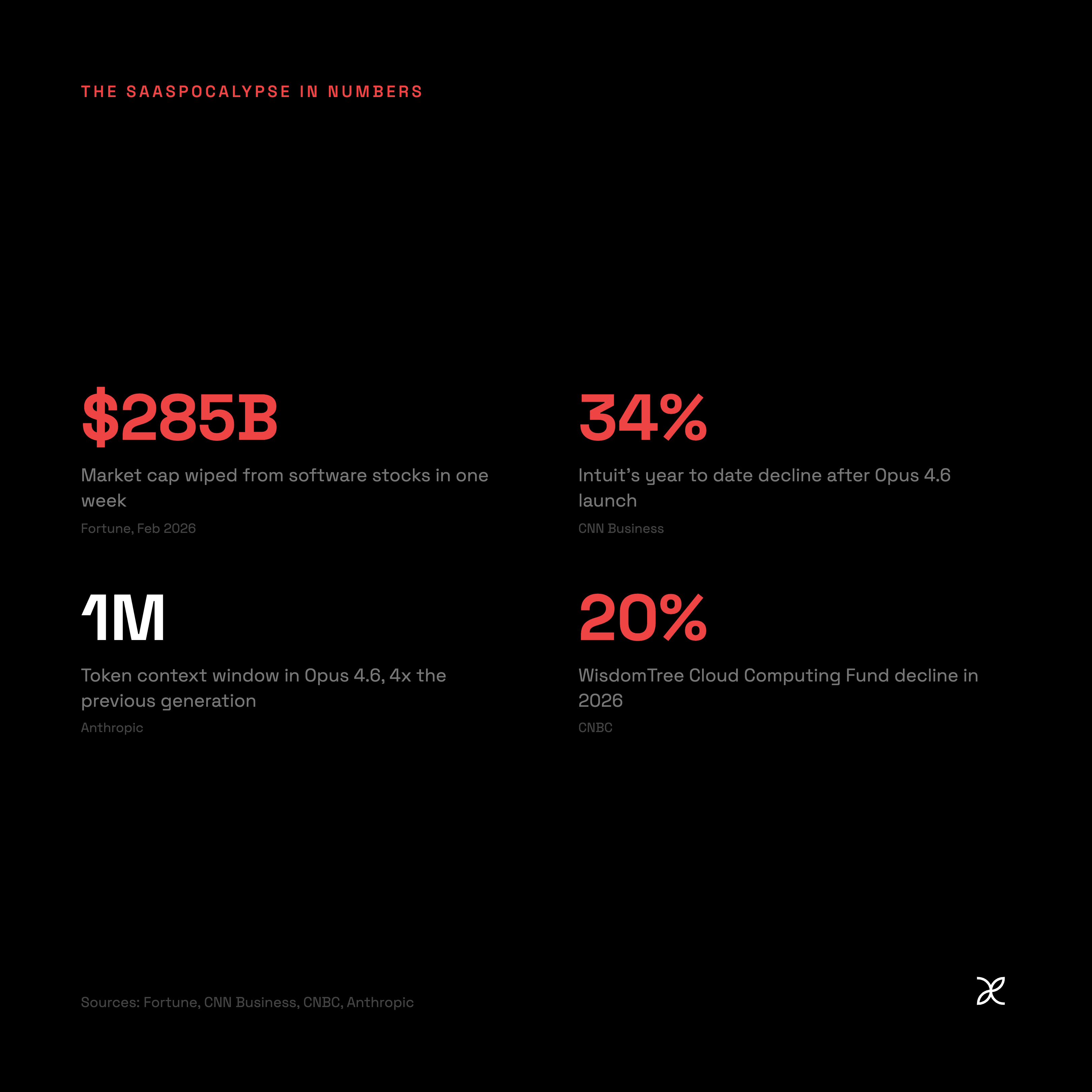
In the first week of February 2026, approximately $285 billion in market capitalisation evaporated from enterprise software stocks. The trigger was not a recession, a rate hike, or a geopolitical crisis. It was a product update from a four year old AI company.
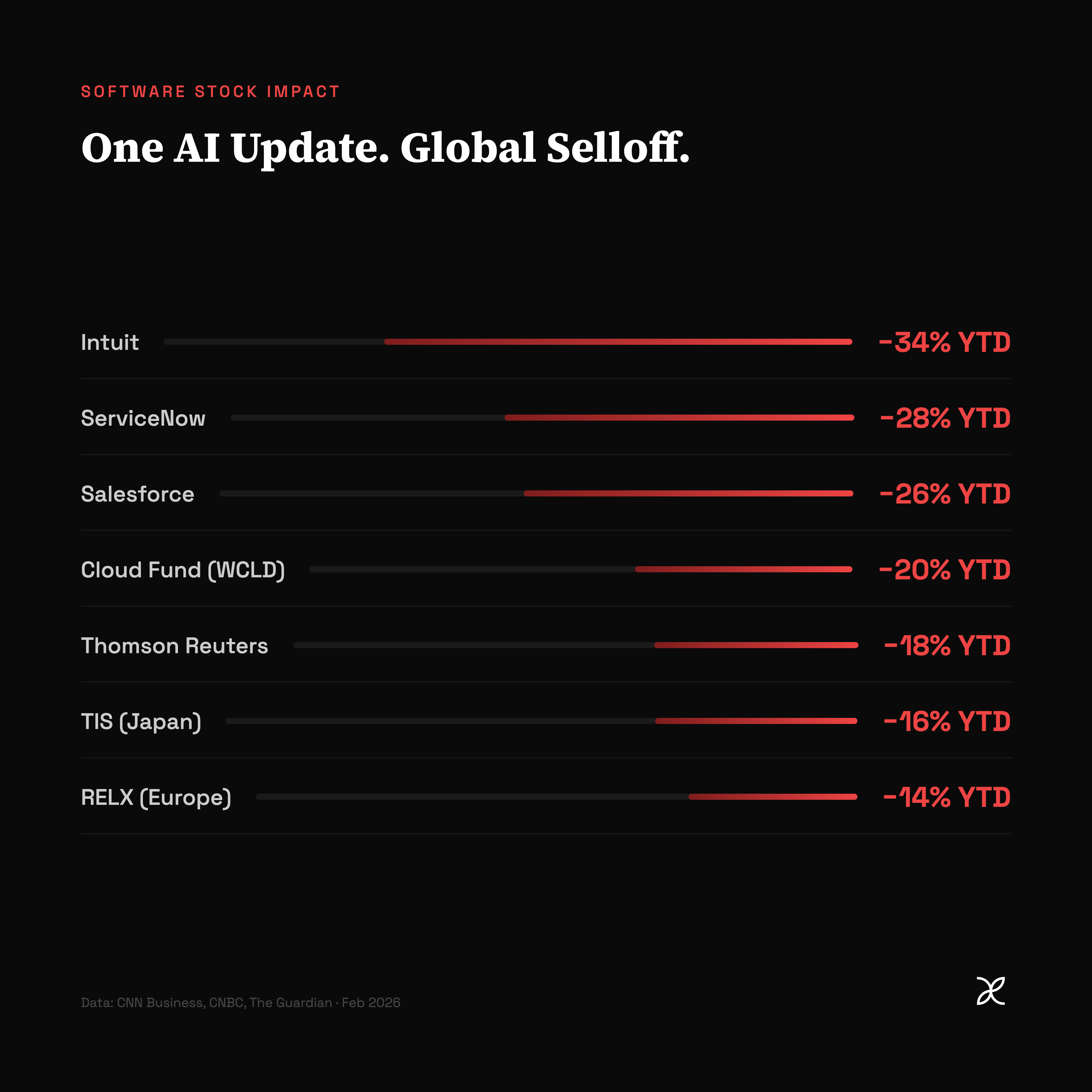
Anthropic's rollout of Claude Cowork industry plugins and the subsequent launch of Claude Opus 4.6 sent shockwaves through global markets, wiping out months of gains for companies that once seemed untouchable. ServiceNow tumbled nearly 7% in a single session, pushing its year to date losses to 28%. Salesforce dropped about 7%, bringing its 2026 decline to almost 26%. Intuit, parent of TurboTax, fell nearly 11% and is now down more than 34% for the year.
The rout was not confined to the United States. The Stoxx Europe Software and Computer Services index shed more than 5% in a single day, with RELX losing over 14% and Capgemini dropping 9.2%. In Japan, IT services provider TIS plunged almost 16%. India's Nifty IT index fell 5.8%. The WisdomTree Cloud Computing Fund has plummeted roughly 20% so far in 2026, including a 6.5% drop in a single week.
Analysts are calling it the "SaaSpocalypse." And unlike previous AI scares, this one has teeth.
What Actually Happened#
On February 3, Anthropic released specialised plugins for its Claude Cowork platform targeting legal, finance, sales, and data marketing workflows. Cowork, which Anthropic describes as an AI colleague capable of reading files, organising folders, and drafting documents, suddenly looked less like a chatbot and more like a replacement for entire categories of software.
Two days later, Anthropic doubled down. Opus 4.6 arrived with a 1 million token context window, dramatically improved coding and professional task performance, and a new "agent teams" feature that lets multiple AI agents split larger projects into segmented jobs, coordinate with one another, and work in parallel. Fortune reported that on select real world professional benchmarks, Opus 4.6 outperformed OpenAI's GPT 5.2.
The same day, OpenAI launched Frontier, an enterprise platform designed to let large companies build, deploy, and manage fleets of AI agents that plug into existing systems. As Fortune described it, Frontier acts as "a semantic layer for the enterprise that all AI coworkers can reference." The platform connects databases, CRM systems, ticketing tools, and internal applications, then allows AI agents to run processes across all of them.
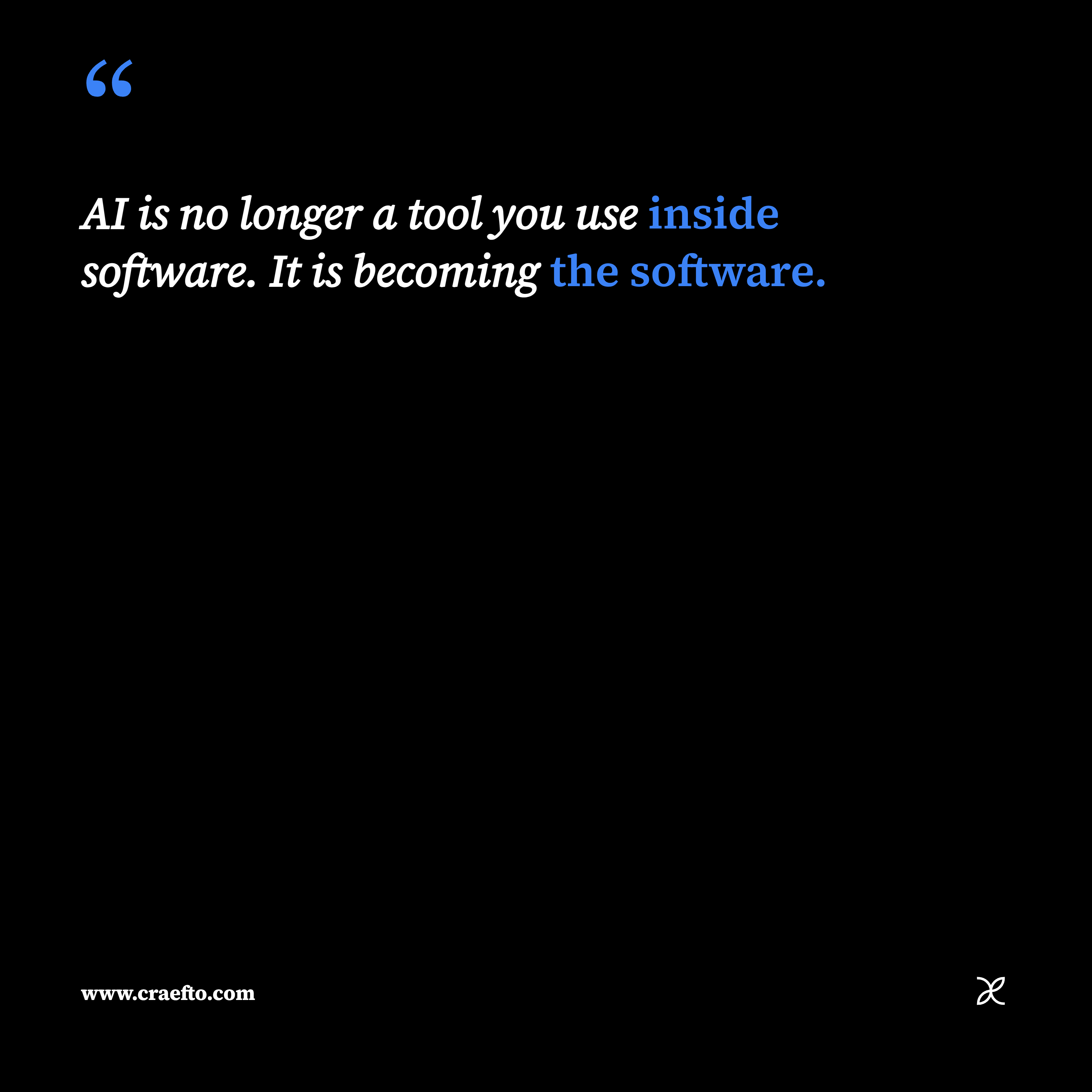
Two of the world's most powerful AI companies, in the same week, declared that AI is no longer a tool you use inside software. It is the software.
Why This Matters More Than Previous AI Hype#
The critical shift is functional. Previous AI releases improved how people interact with existing software. This generation replaces the software itself.
Claude Cowork's legal plugin can automate standard NDA and compliance triage. Its financial analysis capabilities, combined with the million token context window, allow it to perform screening, due diligence data gathering, and market intelligence synthesis, according to Anthropic. These are tasks that currently sustain the business models of firms like Thomson Reuters (down 18%), FactSet Research Systems (down 10%), and S&P Global.
"AI has turned technology into an even more competitive sport," said Ed Yardeni, president of Yardeni Research. "Software stocks were especially hard hit because Anthropic rolled out new tools for its Cowork product. It's too soon to tell how useful the new tools will be, but investors decided to cut the valuation multiples of software stocks."
Software firms once valued for their sticky subscriptions and dependable renewals are now under scrutiny. AI threatens to automate workflows, squeeze pricing, and lower the barriers for new rivals to enter the market.
Not everyone agrees this is the end. Gartner analysts wrote in a research note that "predictions of the death of SaaS and enterprise applications are premature," arguing that Cowork and its plugins are "potential disrupters for task level knowledge work but are not a replacement for SaaS applications managing critical business operations." Wedbush's Dan Ives noted that large organisations have ingrained workflows that cannot simply be switched overnight.
The nuance matters. This is not the death of software. It is the death of software that exists only to organise information humans could not process on their own. When AI can process it directly, the middleman layer becomes optional.
What This Means for Businesses Building Digital Products#
For companies investing in digital products, automation, and custom software, the implications are immediate and practical.
The build versus buy equation has changed. A year ago, the sensible advice for most businesses was to buy off the shelf SaaS and customise lightly. Today, AI native solutions can be built faster and cheaper than traditional software integrations, and they adapt to your specific workflow rather than forcing you into someone else's.
Vertical SaaS is most vulnerable. If your business relies on specialised software for legal compliance, financial modelling, data analysis, or document management, the value proposition of those tools is eroding in real time. The capabilities Anthropic demonstrated this week are not theoretical. They are shipping now.
Custom AI workflows are becoming a competitive advantage. Companies that invest in understanding how AI agents can be orchestrated across their specific business processes will outperform those waiting for their existing vendors to "add AI." OpenAI's Frontier platform makes this explicit: the future is fleets of AI agents connected to your systems, not a chatbot bolted onto legacy software.
Speed of adoption matters. As Vey Sern Ling, senior equity advisor at UBP, told CNBC: "For the sector to rerate, companies must show that AI can act as a growth enabler rather than just a competitive threat." The same logic applies to every business. The companies that treat AI as infrastructure rather than a feature will define the next era.
Key Takeaways#
-
$285 billion in software market cap vanished in a week. This is not a blip. Global software stocks from the US to Japan to India repriced simultaneously.
-
AI is no longer a feature inside software. It is becoming the software. Both Anthropic's Cowork and OpenAI's Frontier are designed to replace, not enhance, traditional enterprise workflows.
-
The "SaaSpocalypse" is overstated in the short term but directionally correct. Legacy SaaS will not disappear overnight, but companies that exist solely to organise and present information are on borrowed time.
-
Businesses should be investing in AI native architectures now. The gap between companies that build around AI and those that bolt it on will widen dramatically in 2026.
-
Custom digital products and automation are more valuable than ever. Off the shelf software is losing its moat. Tailored, AI powered solutions built for your specific business are the new competitive edge.
The first week of February 2026 was not just a bad week for software stocks. It was the week the market decided that AI is not coming for software eventually. It is here now.
Craefto builds digital products and automation for businesses navigating this exact shift. If your company is evaluating how AI changes your technology stack, let's talk.